The Monsoon School
Adab for the Built Environment and Nature
Continuing Tradition:
In order to build responsibly in an era of climate and cultural detachment, we must frame Adab, which means the practice of right action, and recognizing the proper place of all things within the cosmic order as a central thinking framework of the architecture.
Gain Awareness of The Thinking Framework
INTBAU Malaysia x Monsoon School 2026
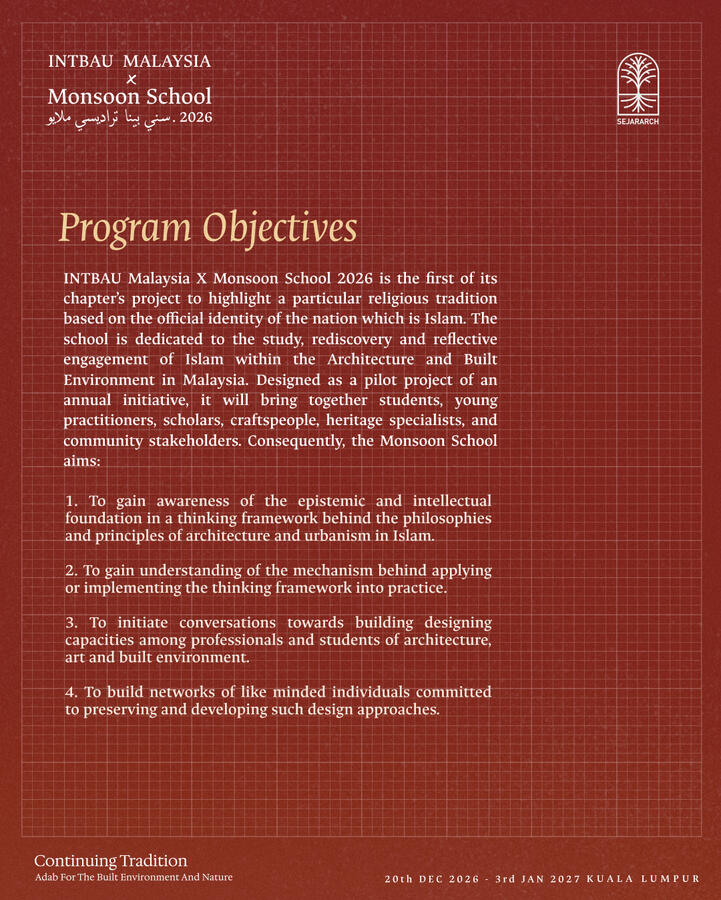
Is the first of its chapter’s project to highlight a particular religious tradition based on the official identity of the nation which is Islam. The school is dedicated to the study, rediscovery and reflective engagement of Islam within Architecture and Built Environment in Malaysia. Designed as a pilot project of an annual initiative, it will bring together students, young practitioners, scholars, craftspeople, heritage specialists, and community stakeholders.
Translate understanding into design decisions
Unifying rigorous theory with practical wisdom
2 week comprehensive educational & design programme
The Monsoon School aims:
To gain awareness of the epistemic and intellectual foundation in a thinking framework behind the philosophies and principles of architecture and urbanism in Islam.
To gain understanding of the mechanism behind applying or implementing the thinking framework into practice.
To initiate conversations towards building designing capacities among professionals and students of architecture, art and built environment.
To build networks of like minded individuals committed to preserving and developing such design approaches.
The Monsoon School
// About Programme
Heritage as a living tradition, bringing intellectual thought into the conversation
Programme Framework
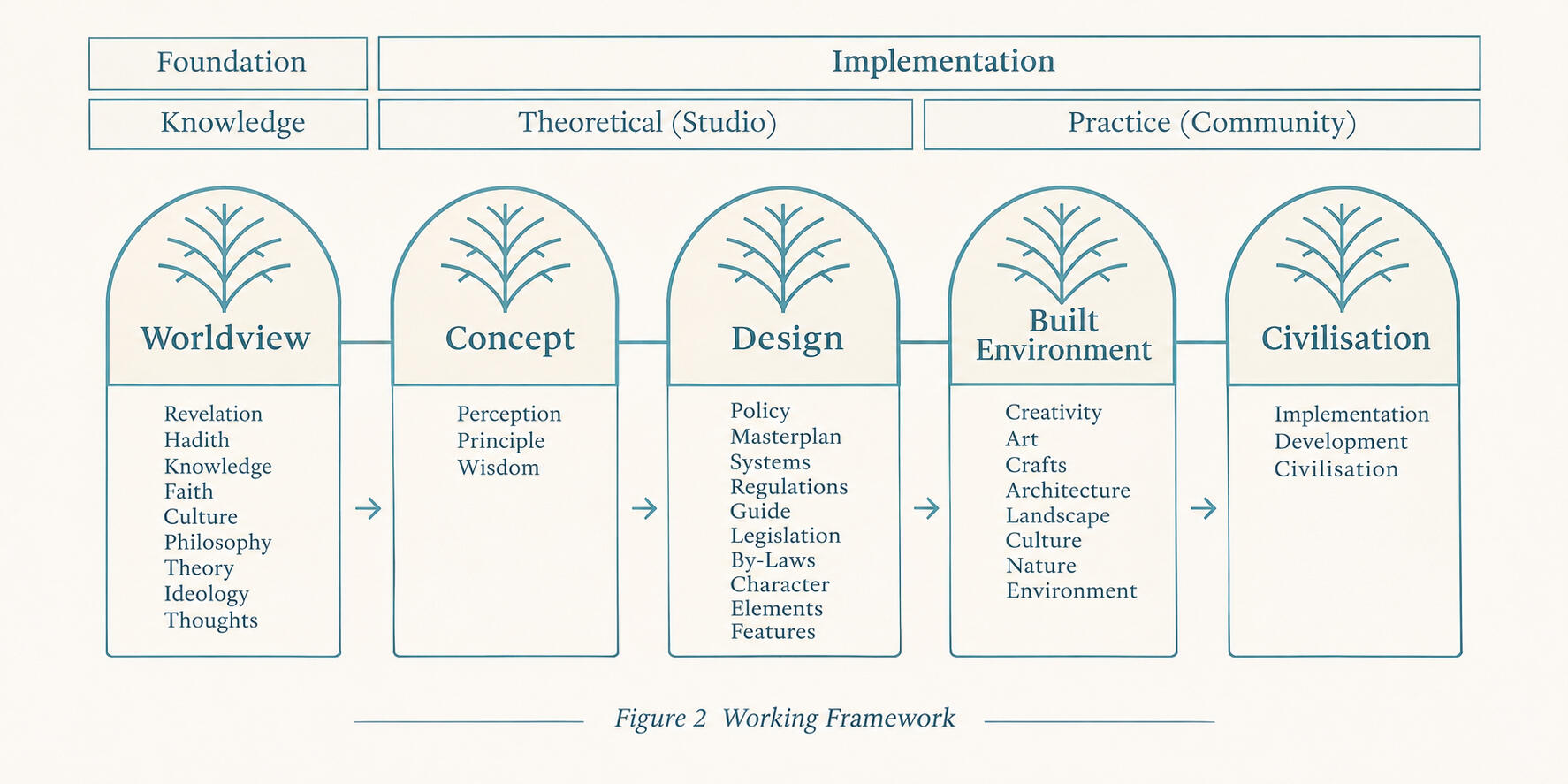
The Monsoon School adopts the Islamic worldview as expounded by Syed Muhammad Naquib al-Attas as its intellectual foundation. This worldview provides a basis for examining the relationship between knowledge, man, nature and civilisation, and how our conception of these relationships shapes the built environment.Central to this worldview is the concept of adab, which entails recognising the proper place of things within the order of existence. Applied to the built environment, it calls for a consideration of the values and principles underlying our creative and design decisions, with the aim of realising justice, order and harmony.The programme introduces a working framework of Worldview, Concept, Design, Built Environment and Civilisation, illustrating how an understanding of reality informs the principles behind what we create and their expression in the physical world.Through lectures, discussions, workshops, design studios and field studies, participants will engage with this framework and explore its relevance to their own professional practice. The emphasis is not merely on architectural forms or design solutions, but on examining the ideas that give rise to them and their wider implications for the built environment.
"Someone asked me how do you make a Muslim City, I said you put Muslims in it“
Abdul Waheed El-Wakil
at INTBAU Qatar Winter School 2025
| Public Talks: | 3 Sessions |
| Lecture: | 6 Module (12 hrs) |
| Workshops: | 3 Sessions (6 hrs) |
| Discussions: | 6 Sessions (6hrs) |
| Design Studio: | 4 Sessions (8 hrs) |
| Excursion: | 2 Sites |
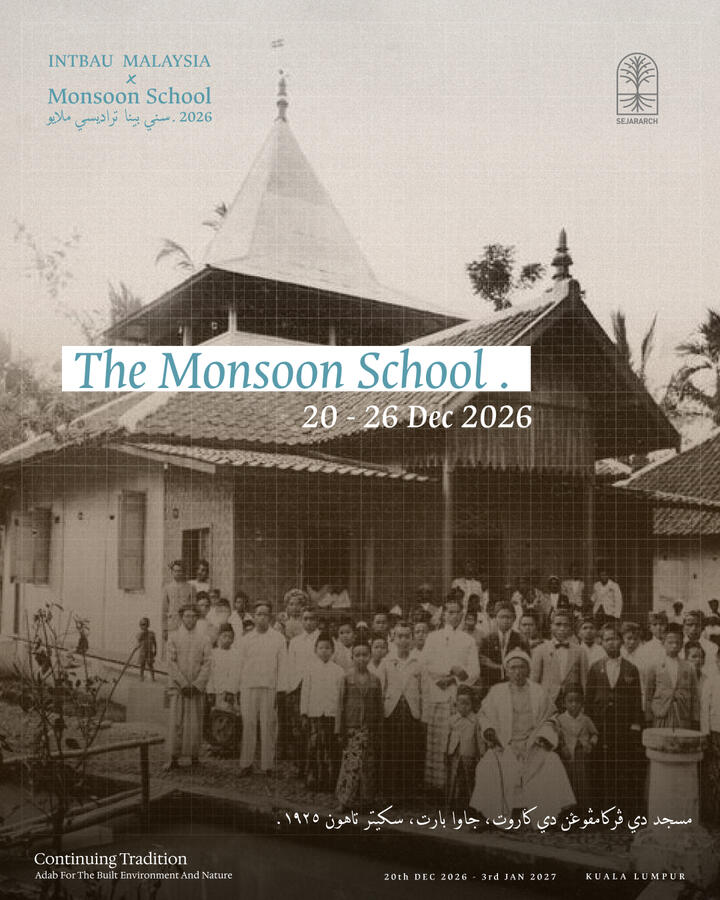
The Monsoon School
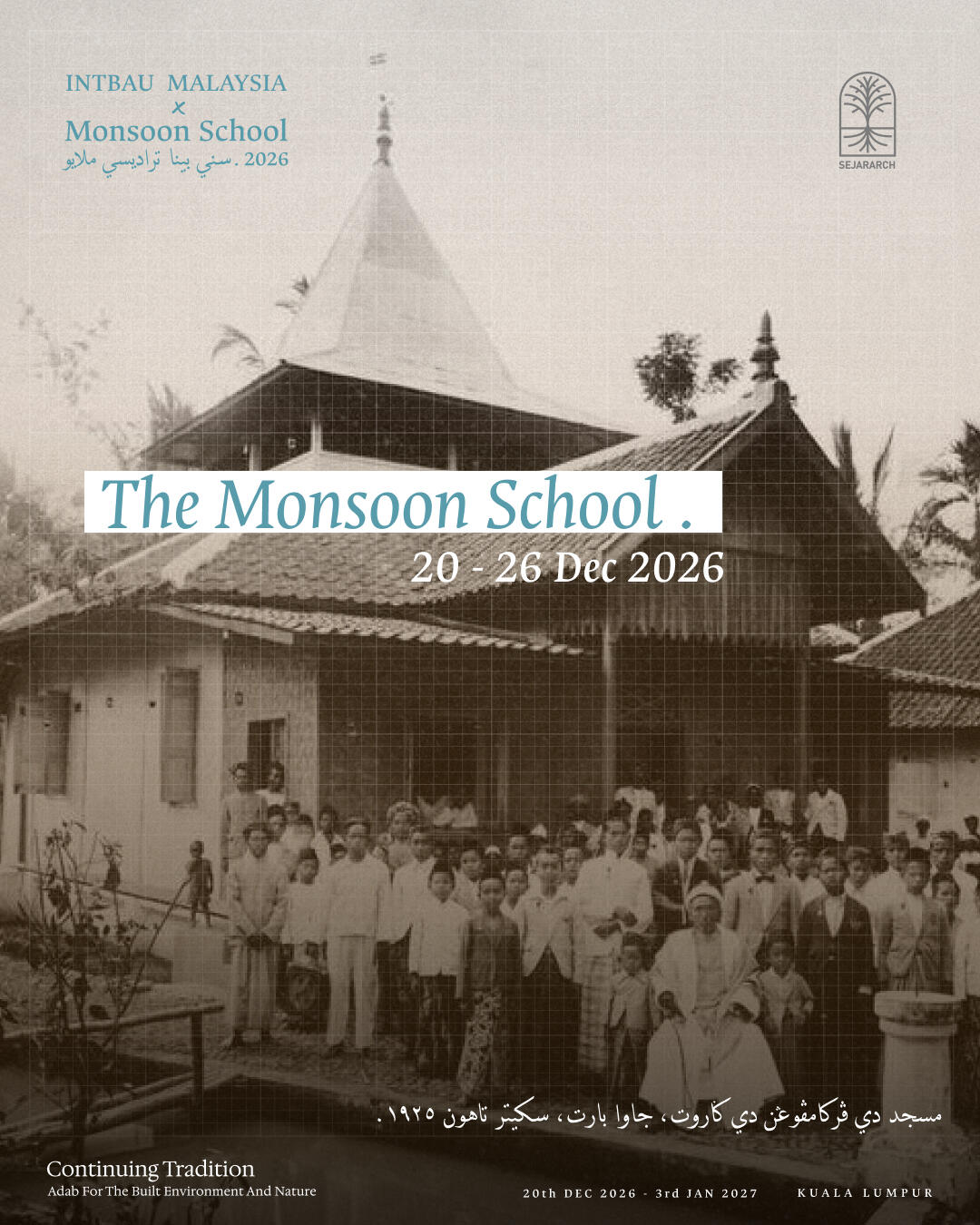
The Monsoon School is a hands-on educational and experiential programme which seeks to address the missing framework that bridges and connects traditional principles (specifically, Islamic) with creative adaptations of contemporary practices in the built environment. Malaysia holds its religious identity as an Islamic country, giving the Monsoon School its particular focus on the Islamic approach to traditional wisdom.The cosmopolitan and multicultural setting in Kuala Lumpur, Malaysia allows the school to identify unique features of what makes an approach ‘Islamic’ through reflecting the historical process of Islamization that occurred in this part of the world. The school reconnects local arts and crafts with the universal principles of Islam within the Nusantara tradition to inform a better environment for the people and nature.
20–26 Dec 2026
7 Days
RM2,500 (625USD)
Programme Structure
The programme encompasses various forms of engagement, including public lectures, sharing sessions, lectures (modules), forums, design studios, discussions, tutorials, workshops, field studies, and visits. These activities are designed to complement one another, allowing participants to develop a foundational understanding of the intellectual framework while exploring its practical applications in architecture, arts, crafts, and design.
The programme will comprise six modules centred on the main theme, each consisting of a two-hour session, including one hour dedicated to questions and answers (Q&A), amounting to a total of 12 hours. Particular emphasis will be placed on post-lecture discussions (6 hours in total), providing participants with opportunities to reflect upon the concepts introduced, relate them to their respective disciplinary backgrounds and existing knowledge, and situate their understanding within the intellectual framework. The Design Studio will be supported by facilitators who will guide participants in translating these concepts and principles into creative design interventions, employing the working framework outlined above as a basis for their design processes.
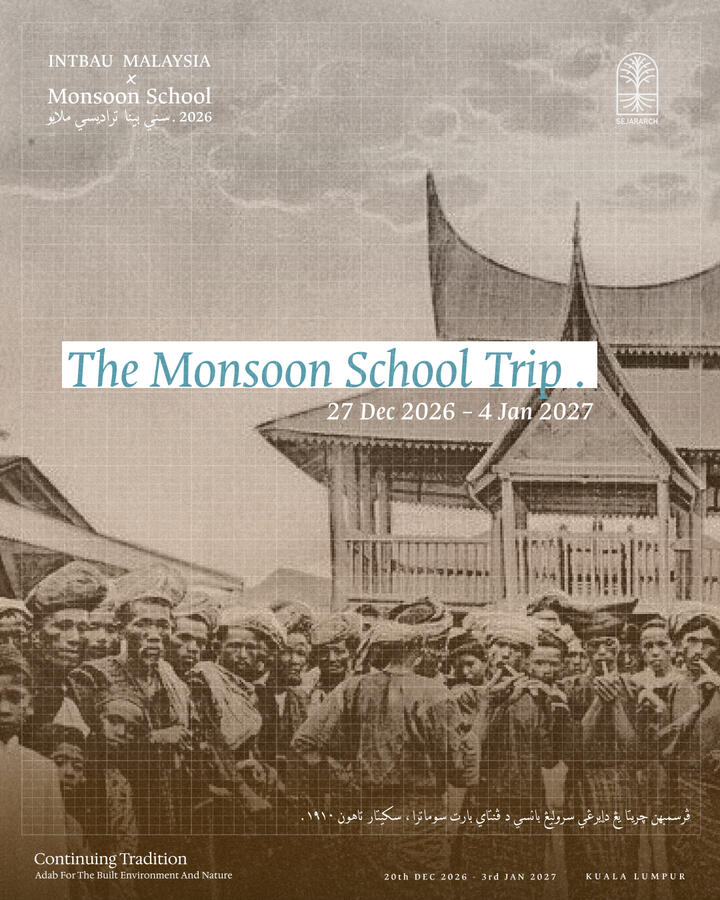
The Monsoon School Trip
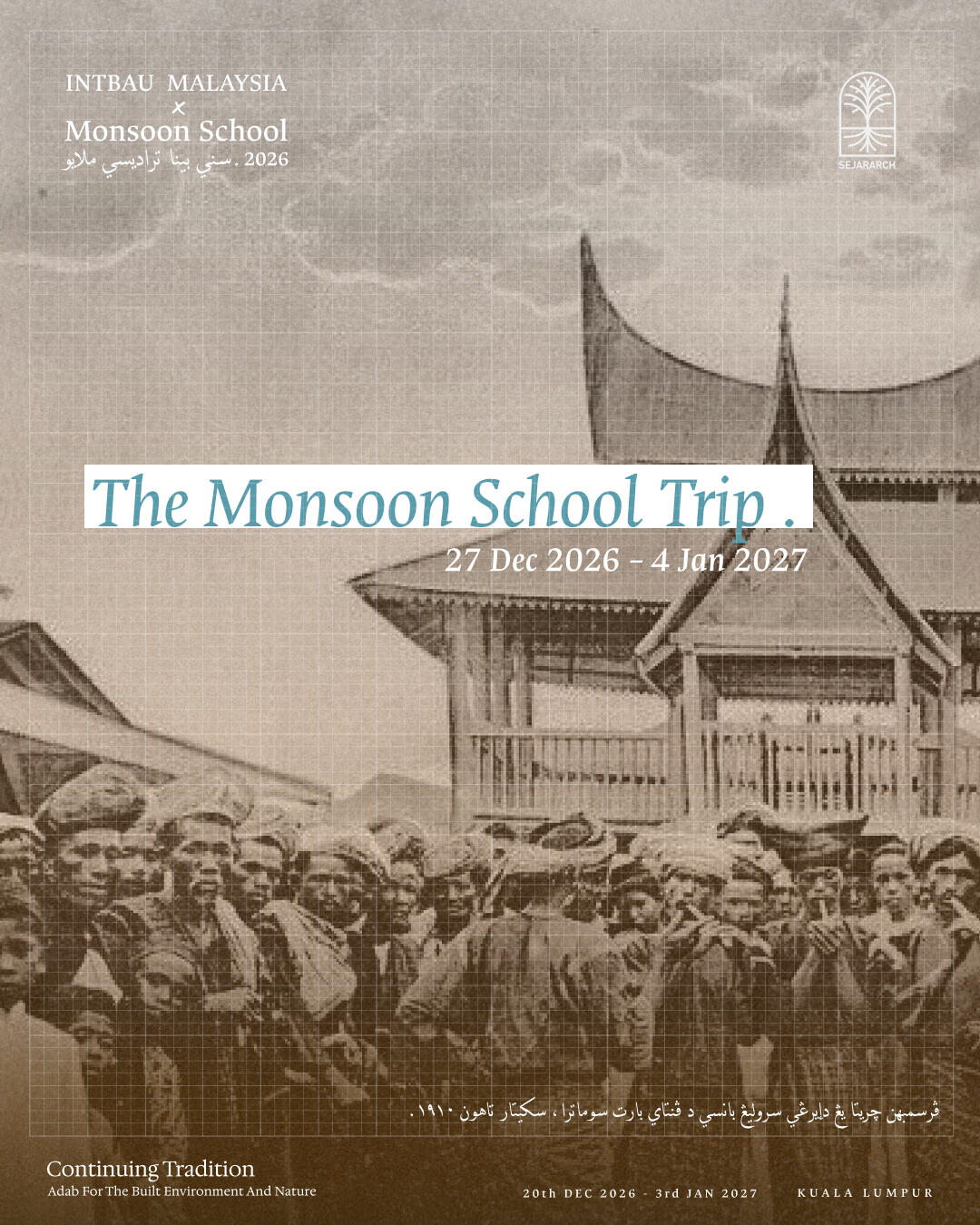
The Monsoon School Trip is an 8 day extension after the Monsoon School programme, it is an optional part of the program where participants from the Monsoon School have the option to extend their participation in an experiential form, going to site visits outside of Kuala Lumpur*, exploring and discovering the cultural aspects of the location. The Trip will bring the participants to locations throughout the North of Malaysia that reflect several elements discussed during the School. We will be tracking mosques, monuments, schools, palaces, old houses, permaculture farms, museums, libraries, and specialized villages. Below are the suggested locations for visits to Terengganu (Besut and Kuala Terengganu), Pahang (Pekan and Janda Baik) and Perak (Kuala Kangsar).
27 Dec 2026 – 3 Jan 2027
8 Days 7 Nights
RM2,500 (625USD)
The Monsoon School Trip is an experiential journey involving architectural visits, cultural exploration and encounters with local places and practices.Participants will visit selected mosques, traditional buildings, heritage sites, craft villages, museums and other places of architectural and cultural significance. The programme places particular emphasis on experiencing traditional architecture within its original settings, allowing participants to observe its relationship with local culture, materials, craftsmanship and the surrounding environment. This will also be reflected in our choice of accommodation and places of visit.The trip is planned around a moderate and affordable standard of travel rather than a luxury travel arrangement. Participants can expect:
Shared accommodation and local dining experiences.
Outdoor visits, local transportation and some walking between sites.
Visits to locations where tourist facilities may be limited.
A flexible travel arrangement that follows local conditions and facilities.
| State | Approximately |
|---|---|
| Kuala Lumpur | 8 Identified sites |
| Terengganu | 17 Identified sites |
| Pahang | 12 Identified sites |
| Perak | 11 Identified sites |
Madani society founded upon moral and ethical principles that derived from revealed truth, allows for the existence of religious differences within that society.“Don’t talk of theology, for that reveals differences” he has said, “talk about ethics and moral principles, for here we Muslims, Hindus and Christians will agree.” “This”, he concludes
“is sufficient for living in this world.“
Royal Laureate Professor Syed Muhammad Naquib Al-AttasIn ISTAC Illuminated
Programme Fees:
| . | Programme | Fee | Days | What's Included |
|---|---|---|---|---|
| A | The Monsoon School | RM2,500 (625usd) | 7 Days | Meals, programme Material and Excursions (Accommodation excluded) |
| B | The Monsoon School Trip | RM2,500 (625usd) | 8 Days, 7 Nights | Meals, Transportation & Shared Accommodation |
| C | Combined (Monsoon School + Monsoon School Trip) | RM4,500 (1,115usd) | 15 Days, 7 Nights | Meals, programme Materials, Excursions, Transportation and Shared Accommodation |
IMPORTANT DATES:
| Title | Author | Year | ISBN |
|---|---|---|---|
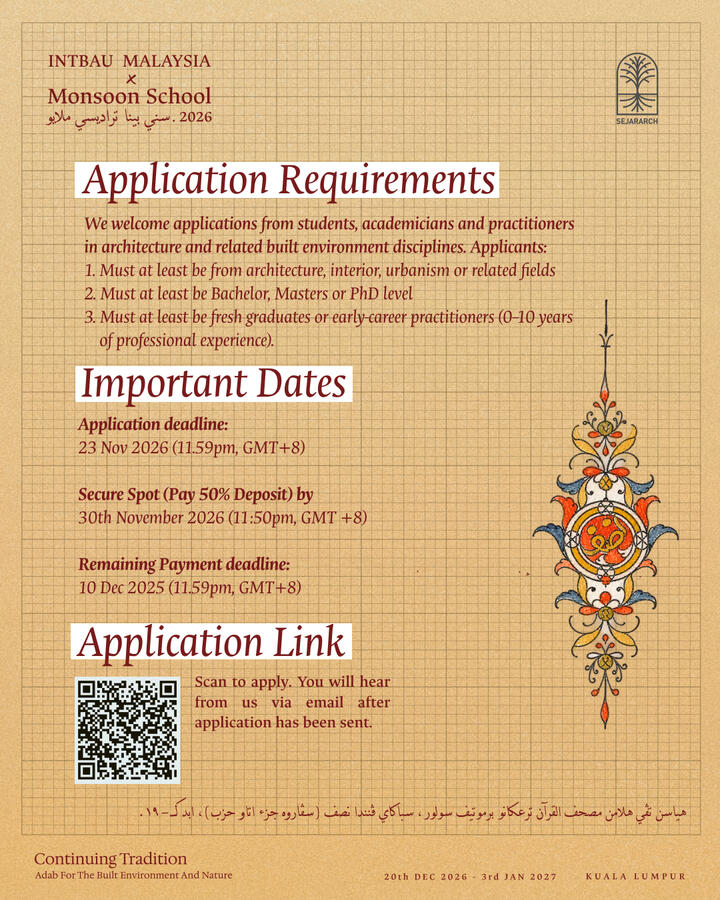
| Application closing date | 23 November | ||
| Application results notification | By 26 November 2026 | ||
| 50% Deposit to secure your place | 30 November 2026 | ||
| Remaining payment deadline | 10 December 2026 |
Bridging Ethics and Aesthetics
To ensure that the architecture we create are based in grounded traditional principles that reflects a metaphysical reality
The recovery of tradition cannot be limited to the revival of inherited forms, techniques, or cultural expressions
It must involve the recovery of the principles of knowledge and meaning that originally gave rise to them.
Programme Format:
The programme will comprise six modules centred on the main theme
Each consisting of a two-hour session, including one hour dedicated to questions and answers (Q&A), amounting to a total of 12 hours. Particular emphasis will be placed on post-lecture discussions (6 hours in total), providing participants with opportunities to reflect upon the concepts introduced, relate them to their respective disciplinary backgrounds and existing knowledge, and situate their understanding within the intellectual framework. The Design Studio will be supported by facilitators who will guide participants in translating these concepts and principles into creative design interventions, employing the working framework outlined above as a basis for their design processes.
Public Lectures & Sharing Sessions
Public lectures and sharing sessions provide opportunities for wider engagement with scholars, practitioners, and the general public. These sessions introduce key themes of the Monsoon School, encourage intellectual exchange, and offer insights into the experiences and practices of individuals working in relevant fields. Some sessions may be held prior to the School to introduce its central concerns and generate public interest.
Lectures and Modules
The lectures throughout the Monsoon School are organised into curated modules that introduce participants to the fundamental concepts and principles of the intellectual framework. Drawing primarily from the works of Syed Muhammad Naquib al-Attas, the modules explore the relationships between worldview, knowledge, man, adab, nature, and civilisation, and their implications for creativity, architecture, and the built environment. These lectures provide the conceptual foundation for subsequent discussions and practical activities.
Forum
Forums bring together scholars and practitioners from different disciplines to examine selected themes and contemporary challenges in architecture, design, and the preservation of traditional wisdom. Through moderated conversations and exchanges of perspectives, participants are encouraged to consider how foundational principles may inform contemporary practices and approaches to development.
Discussion
Discussion sessions provide a space for participants to reflect upon, clarify, and critically engage with the ideas presented in lectures and other activities. These sessions encourage questions, exchanges of interpretation, and the examination of conceptual relationships, allowing participants to deepen their understanding and relate the intellectual framework to their respective disciplines and experiences.
Workshop
Workshops provide hands-on learning opportunities through which participants engage with traditional techniques, materials, craftsmanship, and contemporary design practices. Guided by experienced practitioners and craftspeople, these activities aim to demonstrate how knowledge, skill, and creativity are embodied in the making process, while encouraging participants to appreciate the relationship between traditional wisdom and present-day applications.
Excursions
Excursions provide participants with opportunities to explore selected sites of historical, cultural, and architectural significance beyond the formal learning environment. Through guided visits, participants will encounter examples of traditional and contemporary architecture, craftsmanship, and urban environments, while observing how local wisdom, cultural practices, and environmental considerations have shaped the built environment. These excursions also encourage informal exchanges and interactions among participants, enriching their learning experience throughout the Monsoon School.
Translating intellectual understanding into creative design interventions
Design Studio
The design studio serves as a collaborative platform for participants to translate their intellectual understanding into creative design interventions. Working individually or in groups, participants will explore how the principles introduced in the modules may inform design decisions, spatial relationships, material choices, and approaches to the built environment. The studio encourages experimentation while maintaining a conscious relationship between creativity, purpose, and harmony.
Design Tutorial
Tutorials offer smaller and more focused learning sessions where participants receive guidance in understanding and applying selected concepts into design works. Facilitated by design tutors, these sessions allow closer examination of readings, design propositions, and questions arising from the modules. Particular attention is given to developing the participants' ability to recognise the relationships between principles and their practical implications.
Field Study
Field studies and visits allow participants to encounter architectural traditions, cultural landscapes, and examples of the built environment through direct observation and engagement. Selected sites will provide opportunities to examine the relationships between architecture, nature, materials, craftsmanship, and the cultural and intellectual principles underlying their formation. These experiences are intended to complement the lectures and studio activities by encouraging participants to recognise how principles of harmony, order, and purpose are manifested in physical forms.